
The Log Book Project (TLBP) began in 2016 with a wartime log book belonging to Cyril Devaux, a Saint Lucia-born Royal Air Force pilot, and an idea conceived by his son, Nick Devaux: to use its unused pages to preserve the signatures and stories of people whose lives both impacted and were shaped by the Second World War.
More than 270 veterans and civilian witnesses from all sides of the conflict eventually signed the log book and shared their experiences. What began as an act of remembrance gradually became a much broader historical undertaking. Each signature opened another perspective, adding new context and allowing a network of tangible connections across the wider conflict to emerge.
Over time, the initiative also began to reveal present-day implications: one of which is a wartime legacy lying beneath the waters of the Caribbean.
In this blog post, we hear from the Log Book Project Team:
Lars Mckie and Nick Devaux
How the Caribbean PPW question emerged
One of the first developments in this widening historical work came in 2017, when a propeller from the passenger-cargo vessel Lady Nelson was recovered in Port Castries, Saint Lucia. It had been blown from the vessel during the German U-boat attack of March 1942, when U-161 entered the harbour and torpedoed both Lady Nelson and Umtata at their berths. Both vessels were subsequently raised and towed away. Umtata was later torpedoed and permanently sunk off Florida, while Lady Nelson was repaired, converted to a hospital ship and returned to service. For the balance of WWII, it transported some 25,000 wounded Canadian veterans to Halifax from the European theatre.
The recovered propeller provided a tangible connection between a Caribbean harbour and the largely overlooked wartime campaign fought across the region. It also prompted deeper questions about the attack and Saint Lucia’s role within the region’s wartime history. As TLBP’s work expanded beyond the collection of signatures in Cyril Devaux’s log book, Nick began recording more extensive interviews with veterans and civilian witnesses whose experiences might otherwise have been lost. These included Catherine Martindale, who was a five-year-old passenger aboard Lady Nelson on the night of the attack, and Haynes Cyril, who served as a medic and assisted casualties in its aftermath. Their testimony, combined with increasingly extensive historical research, helped determine that the attack on Castries was not simply an isolated local incident, but part of a much wider maritime battle zone extending across the Caribbean.
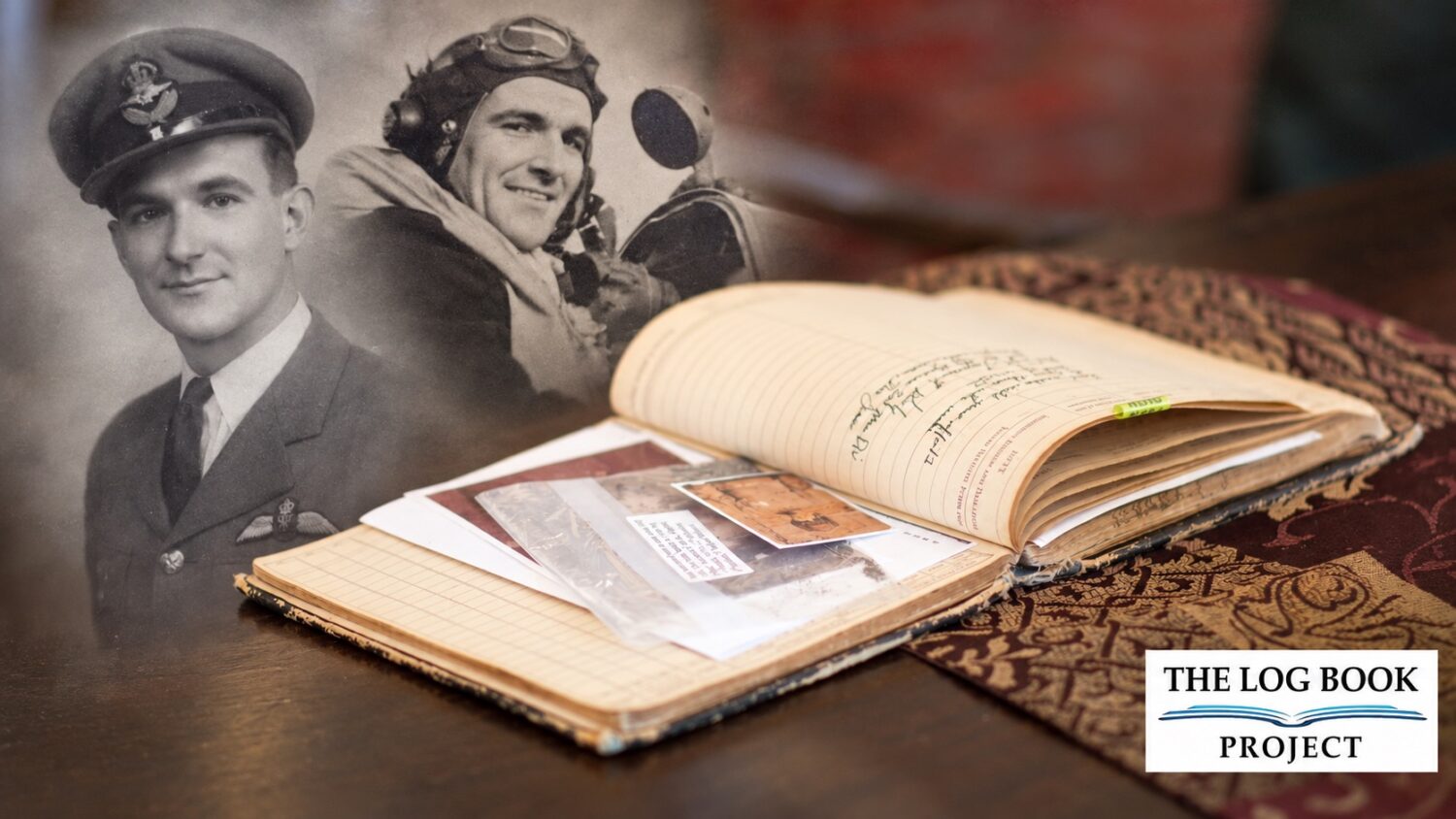
Cyril Devaux, whose wartime pilot’s log book became the foundation of The Log Book Project, shown in RAF uniform and in the cockpit of a Supermarine Seafire alongside the log book whose unused pages later carried the signatures and stories of more than 270 veterans and civilian witnesses.
Those interviews are also central to Oil & Ice Cream, a documentary TLBP is currently producing about the 1942 attack on Castries. As the full scale of the story unfolded, the documentary’s scope expanded to include the PPW dimension – connecting the wartime story with the environmental legacy that the region’s wrecks may still carry.
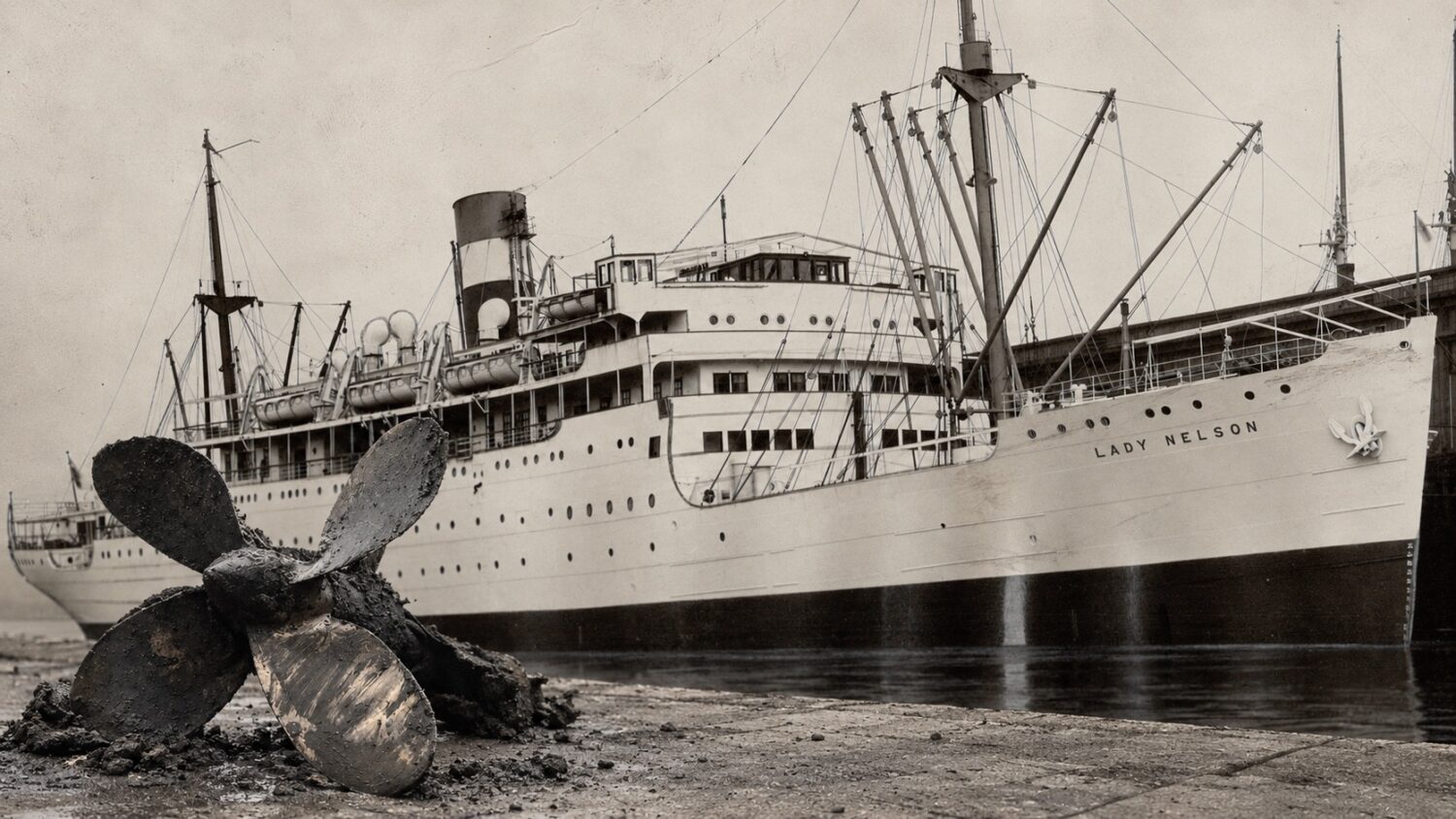
SS Lady Nelson and the propeller recovered from Castries Harbour in 2017—a tangible surviving connection to U-161’s attack on the harbour on 9 March 1942.
Another pivotal development came through TLBP’s connection with author and historian Michael “Mike” Mair. Mike’s father, John A. Mair, served aboard USS Mississinewa (AO-59), a United States Navy fleet oiler sunk at Ulithi in the western Pacific in November 1944. Mike signed Cyril Devaux’s log book on his father’s behalf, adding his name and story, bringing the vessel into TLBP’s historical work.
Through Mike and other sources, we learned that Mississinewa’s wartime movements included an earlier Caribbean chapter. In June 1944, the fleet oiler took on fuel in Aruba and subsequently entered the Pacific via the Panama Canal. Shortly after departing Aruba, however, Mississinewa was forced to take evasive manoeuvres upon detecting the tracking signals of a German U-boat. Mississinewa managed to outrun both its own Naval escort and the enemy U-boat but not its ultimate fate; within 5 months she would come to rest on the bottom of Ulithi Lagoon after being fatally struck by a Japanese Kaiten.
Mississinewa’s environmental legacy emerged nearly sixty years after her loss at Ulithi when continuing oil leakage from the wreck prompted a major operation that recovered approximately 1.8 million gallons of oil.
Mike presented Nick with a small vial containing oil from the wreck during their first in-person meeting in September 2026. By then, TLBP’s Caribbean PPW research was well established. The vial gave physical form to a connection that had emerged gradually between personal memory, wartime historical research and a continuing environmental legacy.
It also served as a tangible reminder of the question that had followed from Mississinewa’s story: if a vessel with an earlier Caribbean chapter could subsequently become a potentially polluting wreck in the Pacific, what might remain aboard the tankers sunk within the Caribbean itself?
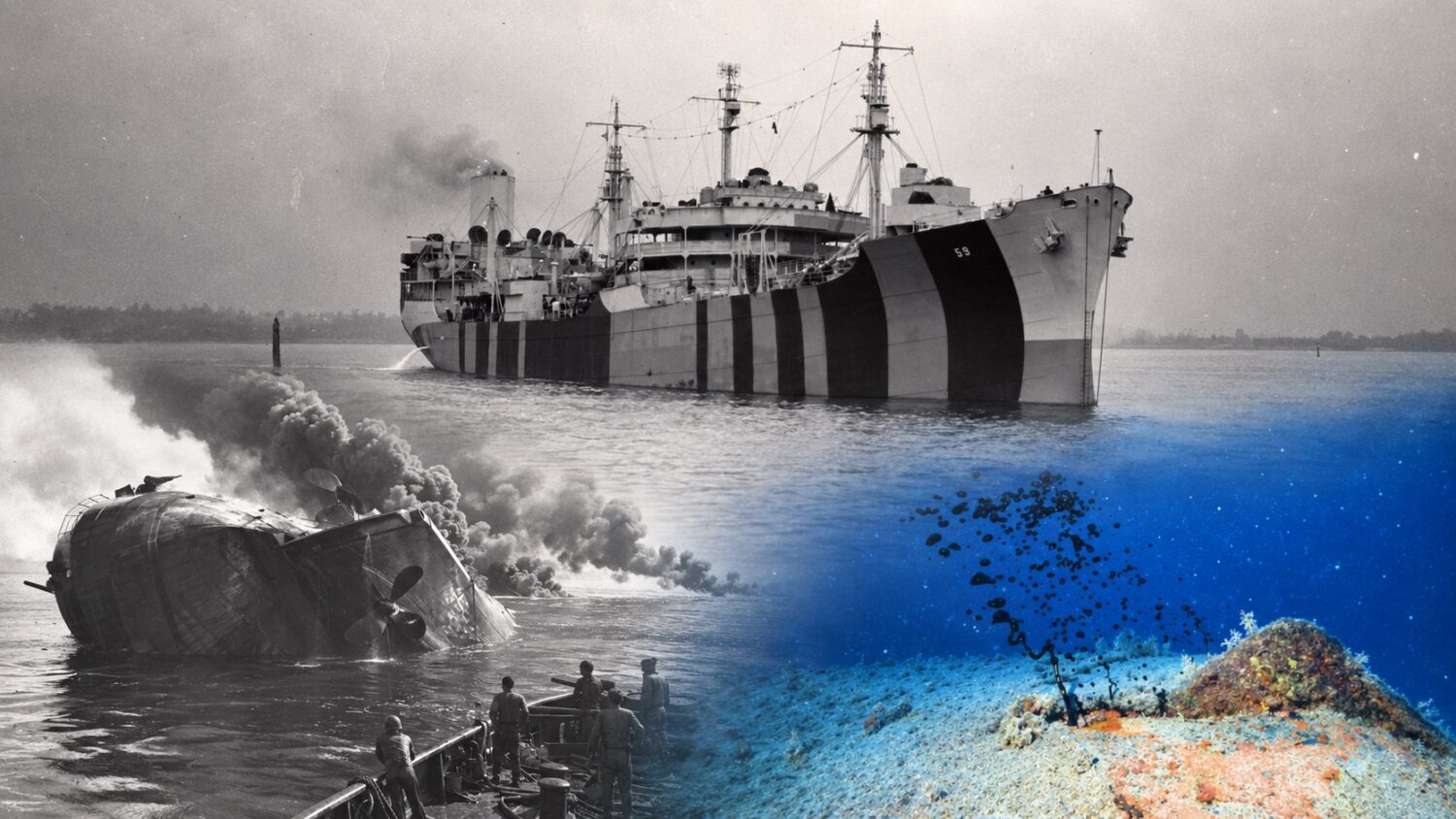
USS Mississinewa (AO-59), shown afloat in 1944, sinking at Ulithi Atoll on 20 November 1944, and leaking oil from the wreck in September 2001—a visual sequence connecting her wartime loss with its continuing environmental legacy.
Bringing the Caribbean to Project Tangaroa
When TLBP first met representatives of Project Tangaroa during an online meeting in November 2024, our historical research had already established a broad sense of the scale of wartime shipping losses across the Caribbean. The PPW field itself was new to us, but the regional evidence already raised important questions. Over the following eighteen months, that emerging question developed into a regional PPW dataset and a structured screening methodology.
We knew that approximately 300 wartime vessel casualties had been recorded across the wider Caribbean. We understood the scale of Operation Neuland and the subsequent German U-boat campaign against the region’s ports and shipping routes, and we knew that some of the vessels lost were oil-carrying tankers. We had not yet established how many tankers had sunk carrying petroleum cargoes, or what the surviving records could reveal
about the types and quantities involved.
At the time, the Caribbean did not yet form part of Project Tangaroa’s geographical picture. TLBP therefore brought its Caribbean casualty research—and the regional PPW question emerging from it—into the discussion. The meeting, in turn, helped transform that question into the targeted research programme that followed.
Recognising the importance of the Caribbean evidence, Project Tangaroa has been tremendously supportive of TLBP’s work. Through that relationship, TLBP became connected with a wider international community concerned with the historical, environmental, technical and legal dimensions of potentially polluting wrecks. TLBP, in turn, brought the largely overlooked Caribbean region and its casualty record into the wider PPW conversation.
As the relationship developed, Nick attended Project Tangaroa’s Data and Archives workshop in Malta in March 2025, taking with him Cyril Devaux’s wartime pilot’s log book—the object from which TLBP’s journey had begun.
Later that year, Project Tangaroa’s Insight Report, Potentially Polluting Wrecks: Protecting People and Planet, provided an early opportunity to introduce the Caribbean situation to a wider audience. The findings presented there reflected an initial stage of our research and have since been refined through the more systematic research programme that followed.
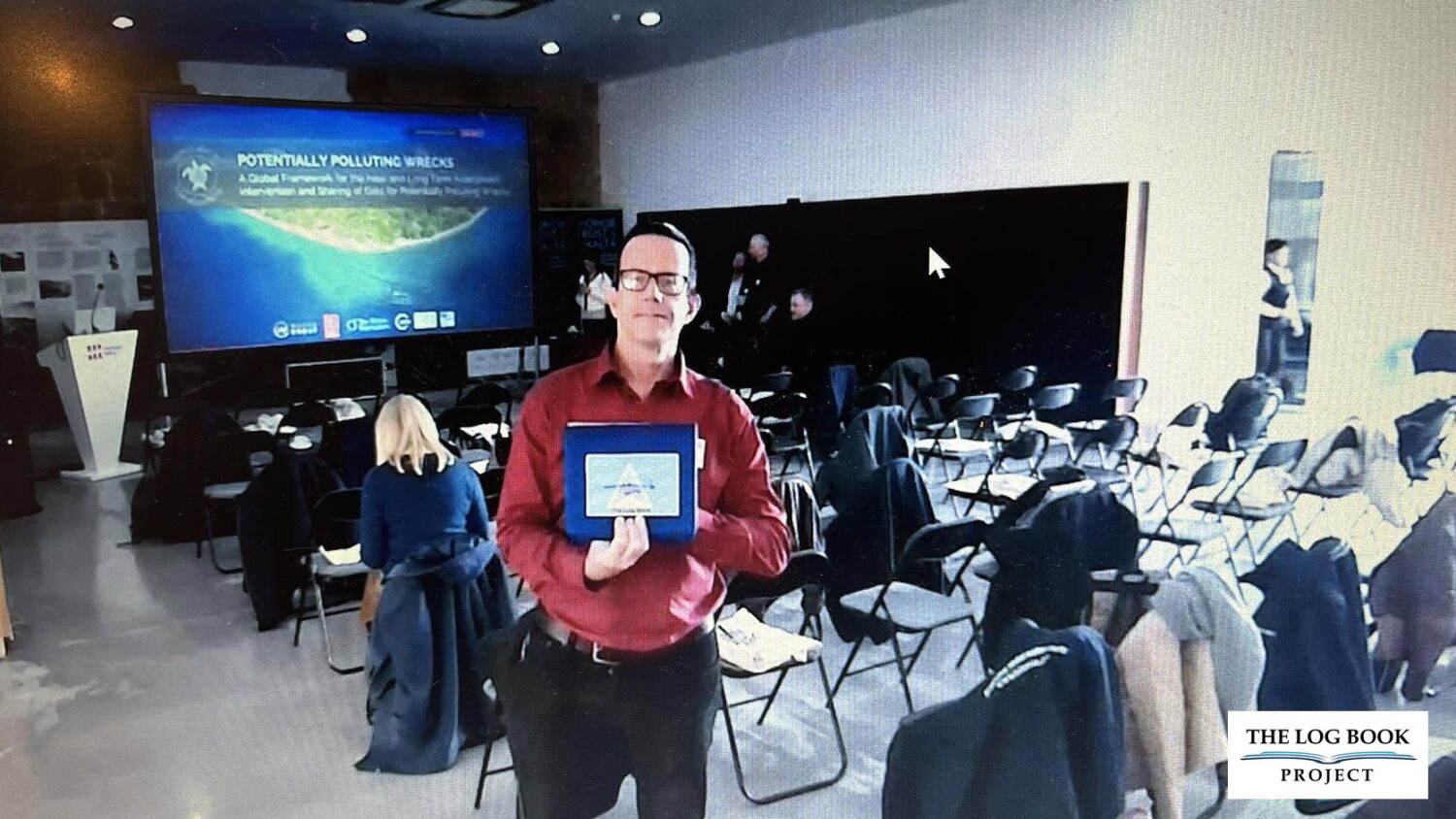
Nick Devaux with Cyril Devaux’s wartime pilot’s log book at Project Tangaroa’s Data and Archives workshop in Malta, March 2025—bringing the object from which TLBP’s journey began into the emerging international PPW conversation.
From a question to an evidence base
The discussions that followed our first meeting with Project Tangaroa helped turn a broad historical question into a more targeted one: which Caribbean tanker casualties had actually been carrying petroleum cargoes when they sank, and what could the surviving records reliably establish about them?
Answering that question required a systematic comparison of vessel identities, cargo records, loss circumstances and reported positions. The resulting findings were published in July 2026 as Technical Paper TP-001, Phase 1 Screening of WWII Tanker Casualties. The paper refined our preliminary findings and established the programme’s current historical evidence base.
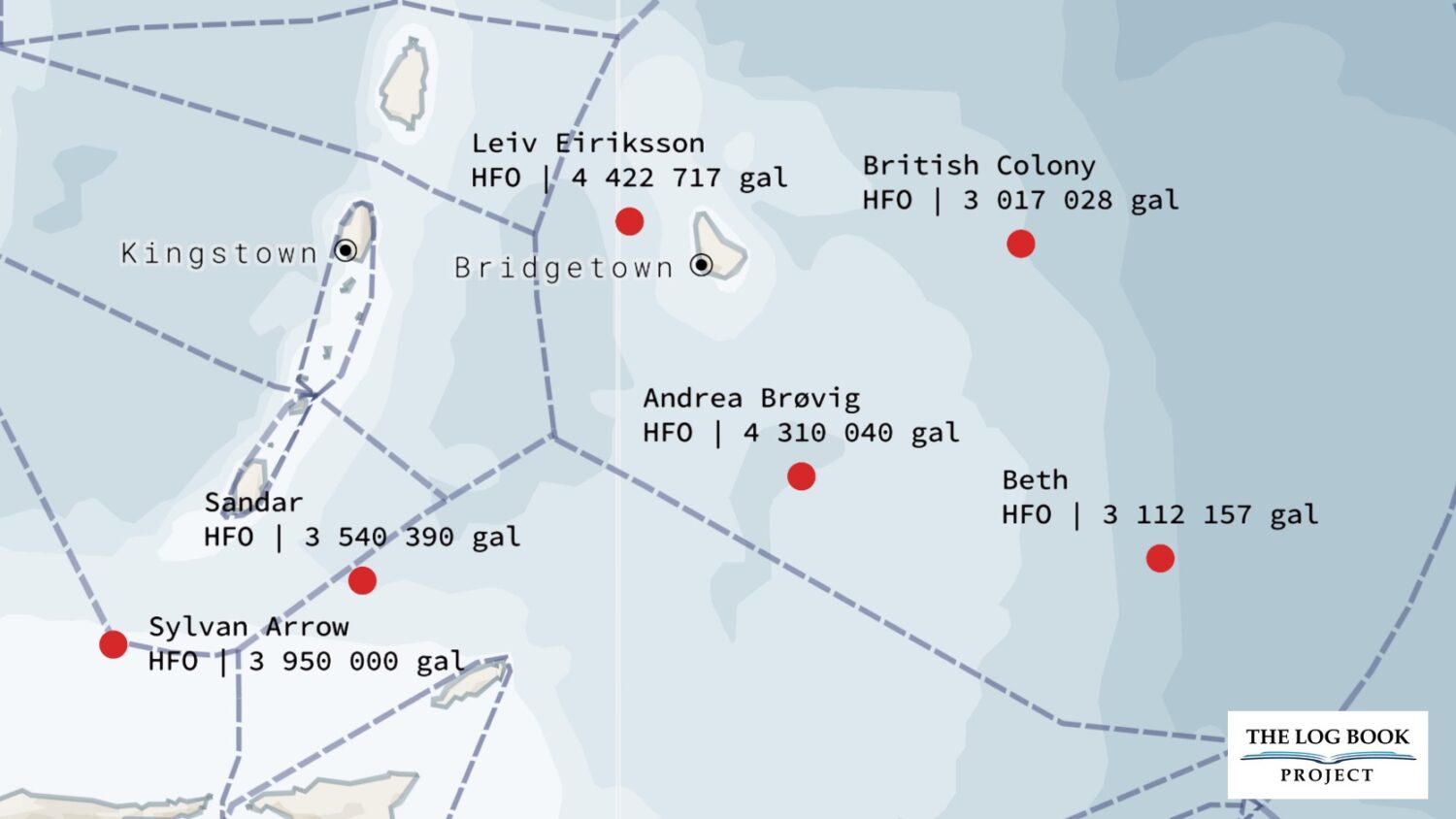
Extract from the TP-001 regional screening map, showing selected tanker casualties historically recorded as carrying heavy fuel oil in the central and eastern Caribbean, together with the cargo volume with which each vessel sailed. These figures do not represent quantities confirmed as presently remaining within the wrecks.
To ensure that cargo information drawn from different wartime sources could be recorded consistently, TLBP developed the Historic Wreck Cargo Classification (HWCC). It remains the principal method used to classify historical cargo information as research continues.
Neither TP-001 nor HWCC determines the present condition of a wreck or how much cargo may remain on board. Instead, they establish an evidence-based historical record of what surviving sources can support and provide a foundation for future hydrographic, engineering or environmental investigation. Readers wishing to examine the findings, methodology and limitations in greater detail can consult TP-001 directly.
From research to a wider conversation
TLBP’s collaboration with Project Tangaroa has reinforced our understanding that establishing historical evidence is only the initial part of a wider, comprehensive PPW response. The Caribbean PPW issue requires collaborative expertise extending beyond the specialist community already working on wreck pollution. Governments, historians, museums, universities, hydrographers, and coastal and maritime communities all possess knowledge crucial to understanding what lies beneath the region’s waters. The cooperation of relevant regional governments will also be essential to enabling the physical assessment of wrecks in waters within their jurisdiction. Establishing working relationships among these stakeholder groups is therefore critical to future progress.
TLBP has increasingly included the subject in wider historical, academic and public discussions, including guest lectures and presentations to university audiences within and beyond the Caribbean.
Beginning November 2025, TLBP commenced hosting periodic online Caribbean PPW Update forums, inviting contributions and discussion from international and regional stakeholders. Every effort is made to include representatives from local and regional governmental entities including members of the Organisation of Eastern Caribbean States (OECS). The PPW dimension has become a natural part of how we present the region’s wartime story.
TLBP approach employs historical research to initially focus on the largely unseen wreck legacy, reconstructing how and why these casualties came to lie beneath Caribbean waters. The PPW perspective then asks why those wrecks and their surviving records still matter today. Although out of sight, they should not be out of mind. The two perspectives have gradually become mutually reinforcing, each adding context and relevance to the other.
Throughout this development, the work has remained rooted in the people whose experiences began the journey: the veterans, civilian witnesses and families whose accounts revealed the Caribbean’s place within the global conflict. Their testimony keeps the developing PPW conversation connected not only to ships and cargoes, but also to the people and communities shaped by the region’s wartime history.
That human focus must also extend to those living around the Caribbean today and to the generations that will follow. For island and coastal communities whose food security, livelihoods, economies and cultures depend upon a healthy marine environment, a catastrophic release of oil from a deteriorating wartime wreck could threaten the foundations of everyday life.
What comes next?
The next phase will deepen the regional evidence base through further archival research, detailed desk-based studies of individual casualties, improved position assessments, and analysis at national and Exclusive Economic Zone (EEZ) level.
Project Tangaroa has helped provide an international setting in which these regional stories and historical findings can contribute to something larger. TLBP, in turn, has helped bring the Caribbean more firmly into the global PPW conversation. Through the periodic Caribbean PPW Update, we are also connecting regional and international stakeholders and operators while gradually bringing the evidence to the attention of Caribbean institutions and decision-makers.
The small vial of Mississinewa oil presented to Nick by Mike Mair remains a fitting symbol of where these paths intersect. It connects personal memory with physical evidence, a Pacific wreck with its earlier Caribbean chapter, and wartime history with an environmental legacy that endured for decades.
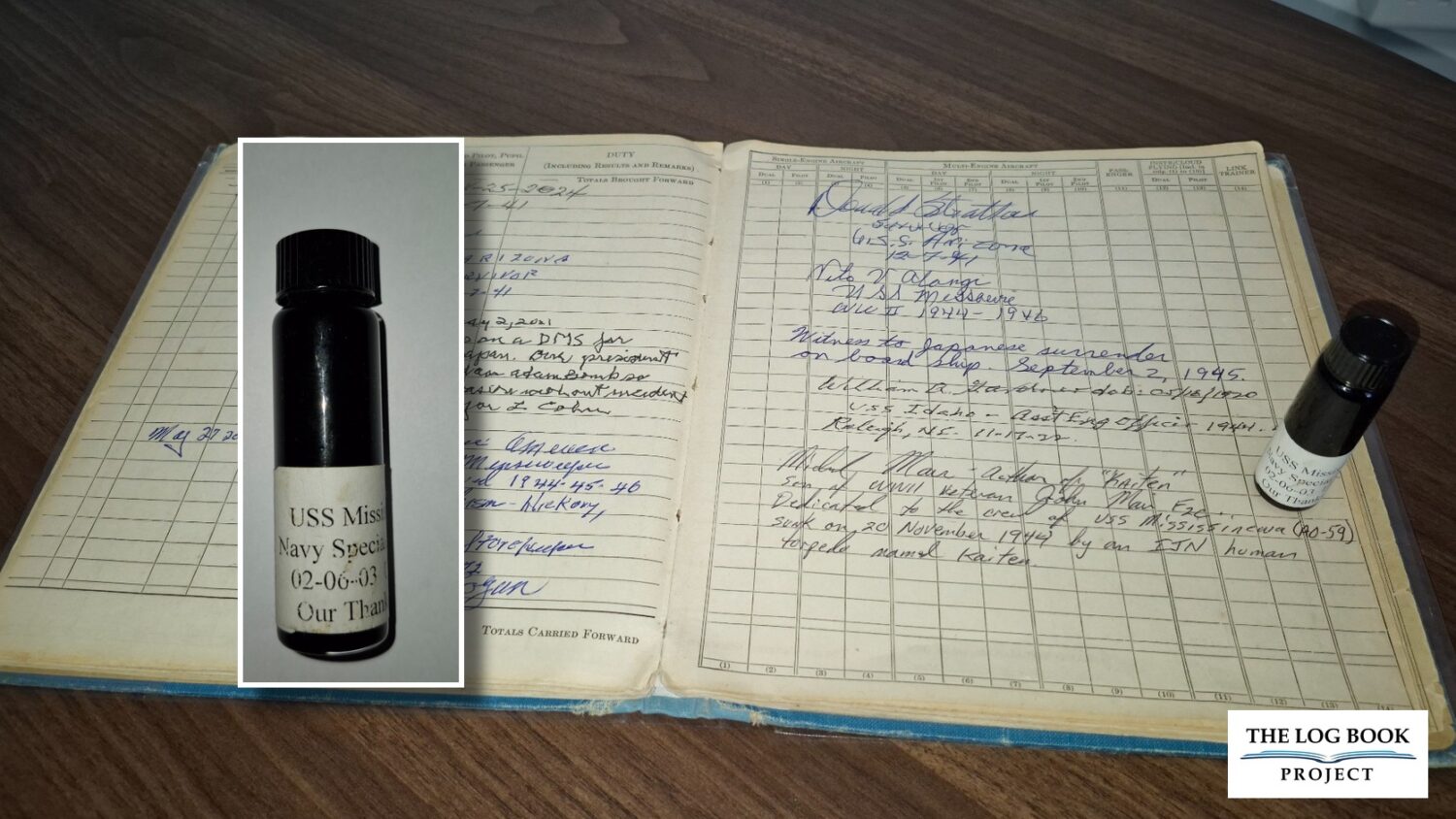
A vial containing oil recovered from USS Mississinewa rests on Cyril Devaux’s wartime pilot’s log book, opened at the page signed by Mike Mair on behalf of his father, John A. Mair, who served aboard the fleet oiler.
Our route into potentially polluting wreck research began with curiosity, listening and reflection. Its future will combine targeted investigation with continued regional engagement and collaboration. We are excited to carry this work into its next phase – strengthening the evidence, widening regional awareness and ensuring that the Caribbean’s wartime wreck legacy, though still out of sight becomes firmly established on the regions’ risk-profile radar.
Further resources
Selected sources
1. Devaux, Nicholas, and Lars McKie. TP-001: Phase 1 Screening of WWII Tanker Casualties. Version 1.2. The Log Book Project Ltd, July 2026. https://ppw.thelogbookproject.com/2026/07/30/technical-paper-tp-001-phase-1-screening-of-wwii-tanker-casualties-1939-1945/
2. Lloyd’s Register Foundation. Potentially Polluting Wrecks: Protecting People and Planet—Insights from the Project Tangaroa Coalition. August 2025. https://www.lrfoundation.org.uk/publications/potentially-polluting-wrecks-protecting-people-and-planet
3. Project Tangaroa. Data and Archives Workshop Programme. Malta, 4–6 March 2025.
4. The Log Book Project archive, including oral-history interviews, correspondence, wartime records and research relating to Lady Nelson, USS Mississinewa and the Caribbean PPW programme. https://ppw.thelogbookproject.com/about/our-path-to-ppws/
Editorial notes
- TP-001 represents TLBP’s current evidence base and refines the preliminary findings
presented in the 2025 Insight Report. - Cargo volumes shown in Image 5 represent the cargo with which each vessel sailed,
not quantities confirmed as remaining within the wrecks. - Historic Wreck Cargo Classification (HWCC) is the correct title of TLBP’s cargo-classification framework.
- The Log Book Project, Historic Wreck Cargo Classification (HWCC) Framework, published 22 September 2026.
https://ppw.thelogbookproject.com/2026/09/22/historic-wreck- cargo-classification-hwcc- framework/